Introduction of the Peptide BPC-157
By: Clark Jones, PhD

The BPC-157 (Body Protection Compound-157) is a research peptide composed of 15 amino acids (Gly-Glu-Pro-Pro-Pro-Gly-Lys-Pro-Ala-Asp-Asp-Ala-Gly-Leu-Val), inspired by a peptide fragment first reported in gastric juice extracts. In the lab, it has been investigated extensively in animal and cell models for its purported regenerative, cytoprotective, and angiogenic effects. However, despite growing interest, its therapeutic relevance in humans remains unsubstantiated by robust clinical evidence.
It is important to note that all scientifically verified effects described below are based on preclinical research, including in vivo rodent models and in vitro cellular systems. There are no approved clinical uses of BPC-157 for humans currently.
Molecular and Cellular Mechanisms
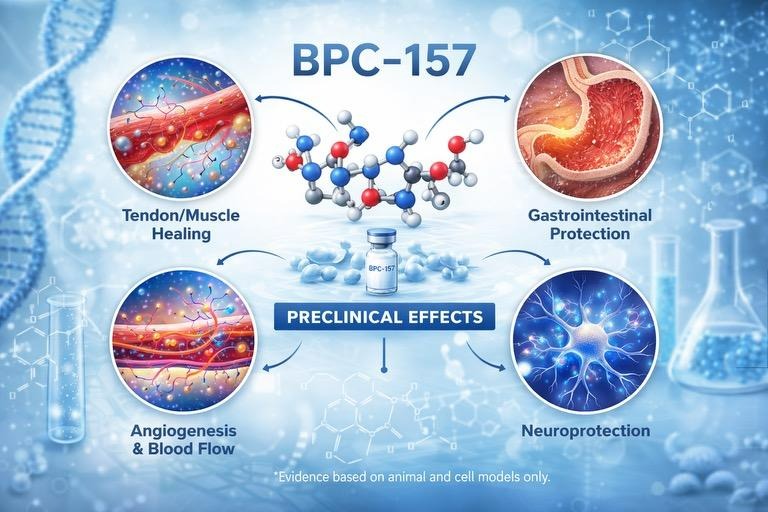
Angiogenesis and Vascular Repair: One of the most consistently reported actions of BPC-157 in research is its influence on angiogenesis, the process of forming new blood vessels. BPC-157 has been shown to:
- Increase vascular endothelial growth factor receptor 2 (VEGFR2) expression.
- Activate downstream signaling through VEGFR2-Akt-eNOS pathways, which support endothelial function and capillary formation (1).
These responses may facilitate enhanced blood flow and nutrient delivery to injured tissues. However, the precise molecular regulation remains incomplete and is actively being studied.
Cell Growth and Cytoskeletal Pathways: Experimental work suggests BPC-157 interacts with intracellular pathways involved in cell survival and migration:
- It influences growth factor signaling such as basic fibroblast growth factor (bFGF), epidermal growth factor (EGF), and elements of focal adhesion networks like FAK-paxillin complexes (2).
- Can also be utilized in the modulation of transcriptional regulators like EGR1 and NAB2, which play a role in gene expression during stress responses (3).
These molecular observations support hypotheses that BPC-157 promotes adaptive cellular behaviors in regeneration models.
Nitric Oxide Modulation: Research has observed that BPC-157 may indirectly affect nitric oxide (NO) signaling, a key regulator of vascular tone and inflammation. Small-animal studies describe loss or activation of nitric oxide–related pathways following peptide exposure, potentially contributing to vascular resilience under stress (1).
Preclinical Evidence Across Tissue Types
Soft Tissue (Muscle, Tendon, and Ligament) Models: Many rodent studies have examined BPC-157 in models of musculoskeletal injury:
- In rat tendon and ligament injury experiments, administration of BPC-157 accelerated collagen organization and improved measures of biomechanical integrity relative to untreated controls (4).
- Enhanced expression of growth hormone receptors in tendon fibroblasts has been observed, which may facilitate cell proliferation and matrix synthesis in regenerating tissues (1).
These effects are hypothesized to reduce inflammation and improve structural recovery, but they remain confined to controlled animal experiments.
Gastrointestinal Protection and Ulcer Models: Research involving chemically induced gastrointestinal lesions reports that BPC-157 can:
- Reduce gastric mucosal damage.
- Modulate inflammatory responses and support mucosal layer integrity.
Such findings underpin interest in BPC-157 as a cytoprotective agent in experimental gastrointestinal injury (5).
Neurological and Ischemic Injury: A handful of research suggest potential central nervous system effects:
- Preclinical Parkinson’s disease models demonstrate that BPC-157 may mitigate motor deficits and pathological changes induced by neurotoxins, although these are early stage and mechanistically complex findings (6).
- In experimental stroke and reperfusion injury models, the peptide has been reported to reduce tissue damage and support recovery, possibly through improved cerebral blood flow and anti-inflammatory activity (7).
These studies illustrate broad investigative interest, but they also underscore that effects vary by model and mechanism.
Pharmacokinetics and Safety in Preclinical Studies
Metabolism and Clearance: In animal models, BPC-157 is rapidly metabolized:
- Liver clearance is reported with a short half-life (e.g., <30 minutes in rodent models) (4).
- Detectable peptide fragments may persist in the urine for a few days (2).
Preclinical Toxicology: Toxicity studies in rodents indicate that even high doses (e.g., 20 mg/kg) do not result in gross organ toxicity or lethality in the acute setting. No significant abnormalities in behavior, weight, or organ histology were observed after standard experimental administration (2). These data suggest a benign safety profile in animal models.
Limitations of the Current Evidence
Lack of Human Clinical Data: Despite an extensive body of preclinical research, there are very few human trials. Where human data exist, they are limited and methodologically weak, often lacking proper controls or large sample sizes. Some reports describe tolerated doses with no immediate side effects but do not assess efficacy. v
Importantly:
- BPC-157 is not FDA-approved.
- Regulatory agencies in sports have banned its use due to performance-enhancing concerns despite lacking therapeutic validation.
Interpretation of Preclinical Models: Animal and cell models provide valuable mechanistic insights, but:
- Rodent biology does not always predict human responses.
- Healing pathways in controlled injuries may behave differently in complex human disease contexts.
Therefore, while preclinical data are compelling for understanding underlying mechanisms, they do not establish clinical benefit. Translational research is required before any therapeutic claims can be substantiated.
The Outlook for BPC-157
BPC-157 remains an experimental peptide with a substantial body of preclinical research suggesting potential roles in tissue regeneration, vascular signaling, and cellular repair pathways. Mechanistic studies indicate involvement with angiogenic, growth factor, and cytoskeletal signaling networks. Animal studies show accelerated healing in tendon, muscle, and organ injury models, and preliminary safety profiles are reassuring in rodent systems.
However, there is no definitive evidence of efficacy in humans, and its status remains investigational pending rigorous clinical research. All known effects discussed here are derived from laboratory models, and careful interpretation is essential when considering relevance to human biology.
*The information presented in this article is provided solely for scientific, educational, and laboratory reference purposes. Any products or materials referenced are intended exclusively for in-vitro laboratory research use and are not intended for human or animal use, including diagnosis, treatment, mitigation, or prevention of any disease. No content herein should be construed as medical, clinical, or therapeutic guidance.
FAQs: BPC-157
Q: What is BPC-157?
A: BPC-157 is a synthetic 15–amino acid peptide derived from a gastric protein fragment. It is primarily studied in cell culture and animal models and is not an approved human therapeutic.
Q: What has research shown so far?
A: Preclinical studies suggest BPC-157 may influence angiogenesis, growth factor signaling, collagen organization, and nitric oxide pathways.
Q: Has it been proven to heal injuries?
A: In animal injury models, BPC-157 has been associated with improved tendon, muscle, and gastrointestinal tissue recovery.
Q: Is it safe?
A: Rodent toxicology studies report low acute toxicity at experimental doses. Comprehensive human safety trials have not been completed.
Q: Why is it not approved for medical use?
A: Despite promising preclinical findings, there is insufficient high-quality human clinical evidence to support regulatory approval.
References
- Gwyer D, Wragg NM, Wilson SL. Gastric pentadecapeptide body protection compound BPC-157 and its role in accelerating musculoskeletal soft tissue healing. Cell Tissue Res. 2019;377(2):153-159. PMID: 30915550. Accessed March 3, 2026.
- Vasireddi N, Hahamyan H, Salata MJ, et al. Emerging use of BPC-157 in orthopaedic sports medicine: a systematic review. HSS J. 2025. PMCID: PMC12313605. Accessed March 3, 2026.
- McGuire F, et al. Regeneration or risk? A narrative review of BPC-157 for musculoskeletal healing. PMCID: PMC12446177. Accessed March 3, 2026.
- Sikiric P, Seiwerth S, Rucman R, et al. Achilles detachment in rat and stable gastric pentadecapeptide BPC-157: promoted tendon-to-bone healing and opposed corticosteroid aggravation. J Orthop Res. 2006;24(5):1109-1117. PMID: 16583442. Accessed March 3, 2026.
- Sikiric P, Seiwerth S, Rucman R, et al. BPC-157 and standard angiogenic growth factors: gastrointestinal tract healing and lessons from tendon, ligament, muscle and bone healing. Curr Pharm Des. 2018;24(18):1972-1989. PMID: 29998800. Accessed March 4, 2026.
- Sikiric P, Seiwerth S, Grabarevic Z, et al. A behavioural study of the effect of pentadecapeptide BPC-157 in Parkinson’s disease models in mice and gastric lesions induced by 1-methyl-4-phenyl-1,2,3,6-tetrahydropyridine. J Physiol Paris. 1999;93(3):277-283. PMID: 10672997. Accessed March 4, 2026.
- BioTech Pharma. BPC-157 research overview. BioTech Pharma website at https://biotechpharma.org/bpc-157-research. Accessed March 5, 2026.