Peptide Purification: A Lab Guide
By: Clark Jones, PhD
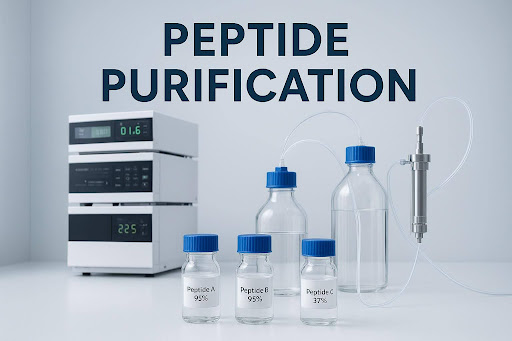
Synthetic peptides are indispensable tools in modern research, serving roles in drug discovery, structural biology, immunology, and biochemistry. However, crude peptides obtained directly after synthesis often contain a mixture of truncated sequences, deletion products, protecting groups, and other byproducts. To ensure accuracy in experiments, these peptides must undergo purification to remove impurities and isolate the target sequence in its highest possible purity (1).
Peptide purification is not a one-size-fits-all process. Different sequences behave uniquely depending on their amino acid composition, length, and modifications. Understanding the principles and methods behind purification is therefore critical for researchers who rely on high-quality peptides in their work.
Why Purification Is Essential
Solid-phase peptide synthesis (SPPS), the most common method of peptide production, is efficient but imperfect. Each coupling step may generate incomplete reactions, and side reactions can introduce errors. Without purification, crude peptide samples often contain a significant percentage of impurities—sometimes up to 70% (2).
For research applications such as binding studies and immunological assays, these impurities can skew results, reduce reproducibility, and even cause off-target biological effects. High-purity peptides (≥95%) are particularly important in sensitive applications like vaccine research or structural biology, where contaminants may interfere with folding or binding properties (3).
Common Methods of Peptide Purification
1. High-Performance Liquid Chromatography (HPLC)
The gold standard for peptide purification is reversed-phase HPLC (RP-HPLC). This technique separates peptides based on their hydrophobicity using a nonpolar stationary phase (commonly C18) and a gradient of polar mobile phases, usually water and acetonitrile containing 0.05% trifluoroacetic acid (TFA) (2).
The advantages of this purification method include high resolution results, scalable procedure, and compatibility with common analytic detection methods such as UV and MS. The drawbacks include the lengthy time it takes, the requirement of expensive instrumentation, and the possibility that some peptides (large sequence peptides or highly hydrophobic) may not resolve well with this technique. Analytical HPLC is often used first to assess peptide purity, followed by preparative HPLC for bulk isolation (1).
2. Size-Exclusion Chromatography (SEC)
SEC separates molecules based on size by allowing smaller peptides to enter porous beads while larger molecules elute faster. While less common than HPLC for purification, SEC is useful for removing aggregates or separating peptides from large contaminants like synthesis resin fragments.
3. Ion-Exchange Chromatography (IEX)
IEX separates peptides based on charge differences at a given pH. This method is particularly effective for peptides with multiple charged residues or when removing charge-based impurities. However, it is less commonly used as a stand-alone technique and often combined with HPLC for fine purification.
4. Crystallization and Precipitation
For certain simple peptides, crystallization or selective precipitation can be applied. This is not as precise as chromatographic methods but can serve as a cost-effective step to enrich the target sequence before further purification.
The Role of Mass Spectrometry and Analytical Validation
Purification is incomplete without validation of purity and identity. The two most common tools are:
- Mass Spectrometry (MS): Confirms molecular weight, ensuring the correct peptide sequence has been synthesized and isolated.
- Analytical HPLC: Provides a chromatogram showing the percentage of the target peptide relative to impurities.
Typically, researchers look for ≥95% purity for biological applications, though some exploratory work may tolerate lower purities if the peptide is well-characterized otherwise.
Factors Affecting Purification Strategy
Not all peptides behave the same during purification. Key factors include:
- Hydrophobicity: Hydrophobic peptides may stick to columns or aggregate, requiring special solvents such as acetonitrile with isopropanol.
- Charge Distribution: Basic or acidic peptides may require ion-exchange steps in addition to RP-HPLC.
- Sequence Length: Longer peptides are more difficult to purify due to greater opportunities for side products.
- Post-Translational Modifications (PTMs): Phosphorylation, acetylation, or PEGylation can change solubility and chromatographic properties.
For example, cysteine-containing peptides may form disulfide bonds or undergo oxidation during purification, requiring reducing agents or oxygen-free conditions.
Workflow for Peptide Purification
The general workflow in a laboratory setting often follows these steps:
- Crude Peptide Collection: After synthesis and cleavage from the solid support, the crude peptide is collected with protecting groups removed.
- Initial Solubilization: The peptide is dissolved in an appropriate solvent system, often water, acetonitrile, or buffers depending on its specific solubility properties.
- Analytical Screening: Small aliquots are tested via analytical HPLC and MS to determine purity profile and confirm the product’s molecular weight.
- Preparative Purification: Based on the analytical data, preparative RP-HPLC is carried out using optimized gradients to separate the main peak from impurities.
- Fraction Collection: Eluted fractions are collected and screened again by analytical HPLC/MS to identify the fractions containing the target peptide.
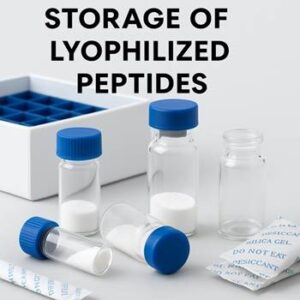
- Pooling and Lyophilization: Pure fractions are pooled, concentrated, and freeze-dried to obtain a stable lyophilized peptide powder for storage.

Common Challenges in Peptide Purification
Aggregation
Hydrophobic or amphipathic peptides often aggregate, complicating HPLC separation. This can sometimes be resolved by using stronger solvents, chaotropic agents, or modifying column conditions.
Low Recovery Yields
Even with effective separation, yield losses can occur due to peptide adsorption on column materials, incomplete recovery, or instability during purification. Optimization of mobile phase conditions and column chemistry can help improve yields.
Oxidation and Side Reactions
Methionine, tryptophan, and cysteine residues are prone to oxidation. Using oxygen-free solvents or adding antioxidants (like DTT for cysteine-rich peptides) can minimize this issue.
Best Practices for Researchers
- Always confirm identity and purity before experimental use with analytical HPLC and MS.
- Avoid unnecessary exposure of peptides to light, oxygen, or heat during the purification process.
- Choose purification levels according to the desired application (preliminary work may allow for lower purities, but structural or binding studies require higher purity for accuracy and reproducibility).
- Document purification conditions carefully, as reproducibility is critical for scaling up peptide synthesis.
FAQ: Peptide Purification
Q: Can I use crude peptides for my experiments?
A: Crude peptides may be suitable for initial screenings, but for reliable results—especially in sensitive biological assays—purified peptides are recommended.
Q: What purity level should I aim for?
A: >95% is standard for most biological research, while ≥98% may be necessary for structural studies or binding assays.
Q: Why is RP-HPLC the most common method?
A: RP-HPLC offers high resolution, scalability, and compatibility with different peptide sequences, making it the most versatile purification technique.
Q: How do I handle peptides that are insoluble after purification?
A: Use solvents or buffers tailored to the peptide’s properties. Hydrophobic peptides may dissolve better in acetonitrile-water mixtures, while charged peptides may require acidic or basic buffers.
Q: Does purification guarantee stability?
A: No. Purification ensures identity and purity, but peptides still need proper storage (lyophilization, inert gas flushing, low-temperature storage) to maintain stability.
References
1.Waters Corporation. Practical Approaches to Peptide Isolation. Waters: Education Primers. Retrieved from: https://www.waters.com/nextgen/us/en/education/primers/practical-approaches-to-peptide-isolation.html
2.Insuasty Cepeda, D. Sebastián; Pineda Castañeda, H. Manuel; Rodríguez Mayor, A. Verónica; García Castañeda, J. Eduardo; Maldonado Villamil, M.; Fierro Medina, R.; Rivera Monroy, Z. Jenny. Synthetic Peptide Purification via Solid-Phase Extraction with Gradient Elution: A Simple, Economical, Fast, and Efficient Methodology. Molecules 2019, 24(7), 1215; https://doi.org/10.3390/molecules24071215
3.GenScript. High Purity Peptide: Higher Purity Peptides, Higher Performance! GenScript—Peptide Purity Resource. Retrieved from: https://www.genscript.com/peptide-purity.html