Natural vs Synthetic PeptideBPC-157 and TB-500 in Regenerative Research
By: Clark Jones, PhD
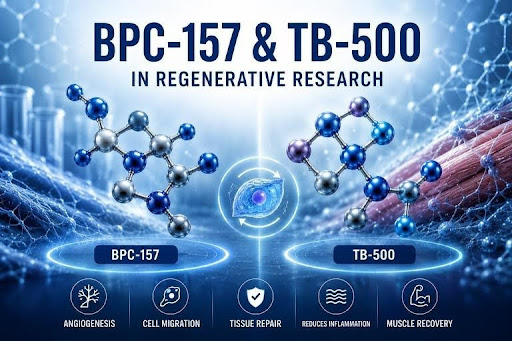
Among the most widely discussed peptides in regenerative biology research are BPC-157 and TB-500. Both have attracted scientific interest because of their reported involvement in tissue repair, angiogenesis, cellular migration, and recovery following experimental injury. Although they are sometimes mentioned together, these peptides are structurally distinct and appear to influence regeneration through different biological mechanisms.
Understanding these similarities and differences is important when interpreting findings from preclinical research models.
What Is BPC-157?
BPC-157 is a synthetic pentadecapeptide consisting of 15 amino acids. It was derived from a protective protein sequence identified in gastric tissue and has been studied in numerous experimental models involving tissue repair and regeneration (1).
Preclinical investigations have explored BPC-157 in models involving:
- Tendon injury
- Ligament damage
- Muscle injury
- Gastrointestinal injury
- Peripheral nerve injury
Preclinical research suggests that BPC-157 may influence multiple biological pathways involved in tissue repair, including angiogenesis, nitric oxide signaling, growth factor regulation, anti-inflammatory properties, and cellular migration (1).
What Is TB-500?
TB-500 is a synthetic peptide fragment derived from thymosin beta-4, a naturally occurring peptide found throughout mammalian tissues. Unlike the full thymosin beta-4 molecule, TB-500 contains only a short amino acid sequence corresponding to the peptide’s actin-binding region (2).
Because of its relationship to actin regulation, TB-500 has been investigated in experimental studies involving:
- Muscle regeneration
- Wound healing
- Connective tissue repair
- Angiogenesis
- Cellular migration
Preclinical research suggests that TB-500 may influence tissue remodeling by supporting cytoskeletal organization and cell movement during repair processes (2).
Similarities Between BPC-157 and TB-500
Despite their different origins, both peptides have been associated with several overlapping biological processes.
Angiogenesis
Both BPC-157 and TB-500 have been linked to angiogenesis which is the formation of new blood vessels from existing vasculature. This process is essential for delivering oxygen and nutrients to healing tissues and is considered a key component of tissue regeneration.
Cellular Migration
Effective tissue repair requires cells to migrate toward sites of injury. Experimental studies suggest that both peptides may influence cellular migration, even though they appear to do so through different molecular pathways.
Tissue Repair Research
Both peptides have been studied in animal and cellular models involving:
- Tendons
- Ligaments
- Skeletal muscle
- Connective tissue
- Vascular tissues
Key Differences Between BPC-157 and TB-500
Although both peptides are associated with regenerative processes, important distinctions exist physically and mechanistically.
| Feature | BPC-157 | TB-500 |
| Origin | Gastric protein sequence derivative | Thymosin beta-4 fragment |
| Length | 15 amino acids | 7 amino acids |
| Type | Synthetic peptide | Synthetic peptide fragment |
| Primary Focus | Signaling and vascular pathways | Actin regulation and migration |
| Research Emphasis | Tendons, ligaments, GI tissues, and nerves | Muscle repair, wound healing, and tissue remodeling |
BPC-157 appears to exert broad effects on biological signaling pathways. Preclinical research has associated the peptide with nitric oxide regulation, angiogenesis, growth factor activity, and vascular function (1).
TB-500, by contrast, is thought to act primarily through mechanisms involving actin dynamics and cytoskeletal remodeling (2). These processes are critical for cell movement, tissue organization, and structural repair.
While both peptides may ultimately influence similar regenerative outcomes, the pathways involved appear to differ substantially.
Can BPC-157 and TB-500 Be Combined?
One reason these peptides are discussed together is that they may influence different aspects of tissue repair.
Preclinical evidence suggests that BPC-157 may play a greater role in vascular support, growth factor signaling, and angiogenesis, whereas TB-500 appears more closely associated with cell migration and tissue remodeling.
Because tissue regeneration requires multiple coordinated biological events, these mechanisms could theoretically complement one another. For example, angiogenesis may help establish an environment conducive to repair, while enhanced cellular migration may support structural rebuilding of damaged tissues.
There is currently a lack of preclinical studies to show the combination effect of these two peptides. The majority of the preclinical research demonstrates the individual use of one or the other to delineate the use, efficacy, and mechanism that contain overlaps upon comparison. Additional research is needed to determine how these pathways interact and whether combined effects differ from those observed with either peptide alone.
Research Limitations
Although both peptides have generated considerable scientific interest, most available evidence comes from:
- Cell culture studies
- Animal models
- Mechanistic investigations
Further research is needed to fully characterize their biological effects and interactions across different experimental systems and in combination if applicable.
Conclusion
BPC-157 and TB-500 are distinct peptides that share a common association with regenerative biology research. BPC-157 is a synthetic peptide derived from gastric protein sequences and appears to influence angiogenesis, vascular regulation, and growth factor signaling. TB-500 is a synthetic fragment of thymosin beta-4 that primarily influences actin dynamics, cellular migration, and tissue remodeling.
While both peptides have demonstrated regenerative effects in preclinical studies, current evidence suggests they operate through complementary rather than identical mechanisms. Understanding these differences is important for interpreting experimental findings and appreciating the complex biological processes involved in tissue repair that could eventually lead to combination research with synergistic effects.
Frequently Asked Questions (FAQs)
Q: What is BPC-157?
A: BPC-157 is a synthetic 15-amino-acid peptide derived from a gastric protein sequence that has been studied in preclinical models of tissue repair and regeneration.
Q: What is TB-500?
A: TB-500 is a synthetic peptide fragment derived from thymosin beta-4 and has been studied for its effects on cellular migration, tissue remodeling, and regenerative processes.
Q: Do BPC-157 and TB-500 work through the same mechanism?
A: No. BPC-157 primarily influences signaling pathways involved in vascular function and growth factors, while TB-500 primarily affects actin dynamics and cell migration.
Q: Why are these peptides sometimes discussed together?
A: Both have been investigated in tissue repair and regenerative biology research and appear to influence overlapping processes such as angiogenesis and cellular migration.
Q: Can BPC-157 and TB-500 be combined in research?
A: Researchers have proposed that their mechanisms may be complementary, but additional studies are needed to better understand their combined effects.
References
- Yuan C, Demers A, Silva-Ortiz V, Hasoon JJ, Lee W, Dave K, Amirdelfan K, Burke HW, Christo PJ, Robinson CL. From Regeneration to Analgesia: The Role of BPC-157 in Tissue Repair and Pain Management. International Journal of Molecular Sciences. 2025;26(10):4726. doi:10.3390/ijms26104726. PMCID: PMC13026520. Accessed June 3, 2026.
- Rahman OF, Lee SJ, Seeds WA. Therapeutic Peptides in Orthopaedics: Applications, Challenges, and Future Directions. Journal of the American Academy of Orthopaedic Surgeons Global Research & Reviews. 2025;9(12): e25.00236. doi:10.5435/JAAOSGlobal-D-25-00236. PMCID: PMC12753158. Accessed June 3, 2026.