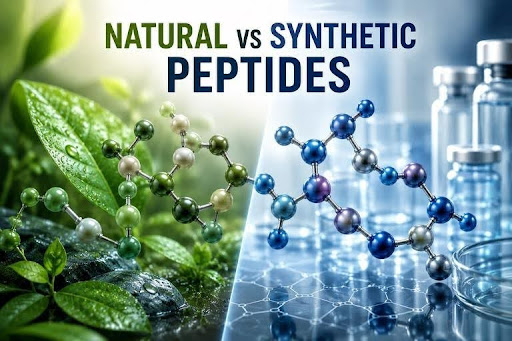
Natural vs Synthetic Peptides
By: Clark Jones, PhD
Peptides have become an increasingly important area of scientific research due to their ability to interact with highly specific biological pathways. While all peptides are composed of amino acid chains, they can generally be categorized into two broad groups: naturally occurring peptides and synthetic peptides.
Natural peptides are produced by living organisms and often serve essential physiological functions, including hormone signaling, immune regulation, cellular communication, and tissue maintenance. Synthetic peptides, on the other hand, are created through laboratory-based chemical synthesis and may either replicate naturally occurring peptides or be intentionally modified to improve stability, bioavailability, or biological activity.
Understanding the differences between natural and synthetic peptides is important when evaluating peptide research, as molecular design can significantly influence biological behavior, pharmacokinetics, and experimental outcomes. This article will go through the differences in structure, function, and research applications of these two groups of peptides.
What Are Natural Peptides?
Natural peptides are short chains of amino acids that are synthesized within biological systems. These molecules function as signaling compounds, hormones, neurotransmitters, growth factors, and immune mediators throughout the body.
Examples of naturally occurring peptides include:
- Insulin
- Glucagon-like peptide-1 (GLP-1)
- Growth hormone-releasing hormone (GHRH)
- Thymosin Beta-4
- GHK-Cu (naturally occurring copper peptide)
Because these peptides evolved to regulate normal physiological processes, they often interact with highly specific receptors and signaling pathways.
One example is GHK-Cu, a naturally occurring tripeptide composed of glycine, histidine, and lysine that binds copper ions. First identified in human plasma, GHK-Cu has been extensively studied for its role in tissue remodeling, extracellular matrix regulation, and cellular repair mechanisms (1).
Natural peptides typically possess highly regulated biological functions but may also have relatively short half-lives due to rapid enzymatic degradation within the body.
What Are Synthetic Peptides?
Synthetic peptides are produced through laboratory-based peptide synthesis rather than biological processes. Researchers may create synthetic peptides for several reasons, including:
- Replicating naturally occurring peptides
- Enhancing stability
- Extending biological half-life
- Improving receptor selectivity
Some synthetic peptides are exact copies of endogenous molecules, while others are modified versions designed to optimize specific characteristics.
Examples of synthetic peptides include:
- Tesamorelin
- TB-500
- BPC-157
- CJC-1295
- Ipamorelin
In many cases, synthetic peptides are engineered to overcome limitations associated with naturally occurring compounds, particularly rapid degradation or poor bioavailability.
Structural Differences
| Feature | Natural Peptides | Synthetic Peptides |
| Origin | Produced by living organisms | Produced through chemical synthesis |
| Structure | Naturally occurring sequence | Natural or modified sequence |
| Half-Life | Often short | Frequently enhanced |
| Receptor Targeting | Physiological regulations | Can be optimized for selectivity |
| Manufacturing | Biological synthesis | Lab synthesis |
Researchers frequently modify synthetic peptides by substituting amino acids, altering peptide length, cyclizing structures, or incorporating non-natural amino acids. These modifications can improve resistance to enzymatic degradation and extend circulation time.
Tesamorelin as an Example of Synthetic Peptide Engineering
Tesamorelin provides an excellent example of how synthetic peptide engineering can improve upon a naturally occurring molecule.
Growth hormone-releasing hormone (GHRH) is a naturally occurring hypothalamic peptide that stimulates growth hormone secretion from the pituitary gland. However, endogenous GHRH has a relatively short half-life, limiting its duration of action.
Tesamorelin is a synthetic analog of GHRH that contains structural modifications designed to increase stability while preserving receptor activity (2). These modifications allow the peptide to remain active for longer periods compared with native GHRH.
This illustrates one of the major goals of synthetic peptide development which is to retain desirable biological activity while improving pharmacological characteristics.
TB-500 and Fragment-Based Peptide Design
Another example of synthetic peptide development is TB-500.
Thymosin Beta-4 is a naturally occurring peptide consisting of 43 amino acids that participates in actin regulation, cellular migration, and tissue repair processes while TB-500 is a synthetic peptide fragment derived from the actin-binding region of thymosin beta-4 (3).
Rather than reproducing the entire endogenous molecule, TB-500 focuses on a specific functional region believed to contribute to several biological activities observed in preclinical studies.
Fragment-based peptide design represents a common strategy in peptide engineering, where researchers isolate biologically active regions of larger proteins or peptides in an effort to simplify synthesis and target specific mechanisms.
BPC-157 and Synthetic Derivatives of Endogenous Proteins
BPC-157 represents another unique example within peptide research.
BPC-157 is a synthetic peptide derived from a protein sequence originally identified within gastric juice. Although the peptide itself is manufactured synthetically, it is derived from naturally occurring biological proteins.
Because of this relationship, BPC-157 occupies a middle ground between naturally derived biological sequences and fully engineered synthetic peptides.
Experimental research involving BPC-157 has explored mechanisms associated with angiogenesis, cellular migration, nitric oxide signaling, and tissue repair pathways (4). However, many aspects of its biological activity remain under investigation.
Advantages of Natural Peptides
Natural peptides offer several potential advantages in research settings.
These include:
- Established physiological roles
- Evolutionary optimization within biological systems
- High receptor specificity
- Extensive biological relevance
Because they are naturally present within the body, researchers often study these peptides to better understand endogenous signaling pathways and physiological regulation.
Natural peptides frequently serve as the foundation for the development of synthetic analogs and next-generation peptide therapeutics.
Advantages of Synthetic Peptides
Synthetic peptides provide researchers with greater flexibility in molecular design.
Potential advantages include:
- Enhanced stability
- Longer half-life
- Improved receptor selectivity
- Greater manufacturing consistency/scalability
- Customizable biological properties
Through peptide engineering techniques, researchers can modify natural peptide sequences to create compounds with improved pharmacokinetic profiles or specialized biological functions.
Many modern peptide therapeutics originated from naturally occurring molecules that were subsequently optimized through synthetic modification.
Research Considerations and Limitations
While synthetic peptides offer numerous advantages, modifications may also alter biological behavior in ways that differ from endogenous peptides.
Even minor changes in amino acid sequence can influence:
- Receptor interactions
- Signaling pathways
- Distribution within tissues
- Metabolic degradation
- Safety profiles
For this reason, findings associated with a synthetic peptide cannot always be directly extrapolated to its natural counterpart.
Similarly, naturally occurring peptides may exhibit complex biological effects that are difficult to fully reproduce using simplified synthetic derivatives.
Conclusion
Natural and synthetic peptides share a common biochemical foundation but differ significantly in origin, design, and research applications.
Natural peptides are produced within living organisms and serve important physiological functions in cellular communication, hormone regulation, tissue maintenance, and immune signaling. Examples include GHK-Cu, growth hormone-releasing hormone, and thymosin beta-4.
Synthetic peptides are manufactured through laboratory synthesis and may either replicate natural peptides or incorporate structural modifications intended to enhance stability, receptor selectivity, or biological activity. Examples include Tesamorelin, TB-500, and BPC-157.
Neither category is inherently superior. Instead, each serves a distinct purpose within scientific research. Natural peptides provide insight into endogenous biological processes, while synthetic peptides offer opportunities to investigate modified molecular structures and optimized biological functions.
As peptide science continues to advance, understanding the distinction between natural and synthetic peptides remains essential for accurately interpreting research findings and appreciating the diverse strategies used in modern peptide development.
Frequently Asked Questions (FAQs)
Q: What is the difference between natural and synthetic peptides?
A: Natural peptides are produced within living organisms, whereas synthetic peptides are manufactured through laboratory-based peptide synthesis.
Q: Is GHK-Cu a natural peptide?
A: Yes, GHK-Cu is a naturally occurring copper-binding tripeptide found in human plasma and other tissues. It has been studied for its involvement in tissue remodeling and cellular signaling.
Q: Is Tesamorelin a synthetic peptide?
A: Yes, Tesamorelin is a synthetic analog of growth hormone-releasing hormone that contains structural modifications designed to enhance stability and duration of activity.
Q: Is TB-500 a synthetic peptide?
A: Yes, TB-500 is a synthetic peptide fragment derived from the active region of the naturally occurring peptide thymosin beta-4.
Q: Is BPC-157 a synthetic peptide?
A: Yes, BPC-157 is produced synthetically, although it originates from a protein sequence associated with compounds identified in gastric tissue. It is generally classified as a synthetic peptide used in research settings.
References
Shah M, Wong M, Blevins T, et al. Tesamorelin: Expanding Applications of a Growth Hormone-Releasing Hormone Analog Beyond HIV-Associated Lipodystrophy. Journal of Clinical Medicine. 2025;14(18):6019. PMCID: PMC12446177. Accessed May 30, 2026.
Pickart L, Margolina A. Regenerative and Protective Actions of the GHK-Cu Peptide in the Light of the New Gene Data. International Journal of Molecular Sciences. 2018;19(7):1987. doi:10.3390/ijms19071987. PMCID: PMC6073405. Accessed May 30, 2026.
Sikiric P, Seiwerth S, Rucman R, et al. Stable Gastric Pentadecapeptide BPC 157: Novel Therapy in Gastrointestinal Tract and Beyond. Current Pharmaceutical Design. 2011;17(16):1612-1632. PMCID: PMC3038486. Accessed May 30, 2026.
Mayfield CK, Bolia IK, Feingold CL, Lin EH, Liu JN, Hatch GFR, Gamradt SC, Weber AE. Injectable Peptide Therapy: A Primer for Orthopaedic and Sports Medicine Physicians. American Journal of Sports Medicine. 2026;54(1):223-229. doi:10.1177/03635465251357593. PMID: 41476424. Accessed May 30, 2026.