TB-500 vs. Thymosin Beta-4
By: Clark Jones, PhD
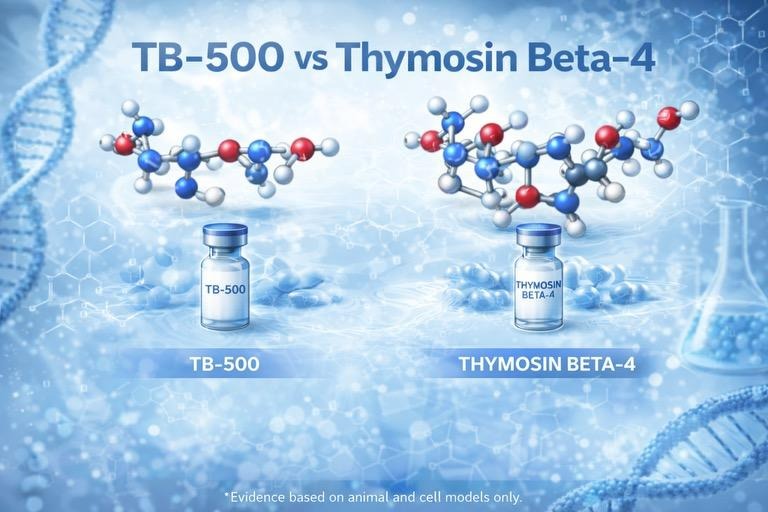
In peptide research, Thymosin Beta-4 and TB-500 are often mentioned together and are sometimes incorrectly treated as interchangeable compounds. Although closely related, they are not the same molecule and have important biochemical differences that affect their structure, mechanisms of action, and research applications.
Thymosin Beta-4 is a naturally occurring peptide composed of 43 amino acids, widely distributed throughout mammalian tissues. TB-500, by contrast, is a synthetic peptide fragment derived from the active region of thymosin beta-4, typically consisting of a 7-amino-acid sequence (LKKTETQ) (1).
Understanding the distinction between these peptides is important in experimental contexts, as differences in molecular structure can influence biological activity, stability, and experimental outcomes.
Molecular Structure and Origin
Thymosin Beta-4
Thymosin Beta-4 is a naturally occurring intracellular peptide present in a wide range of tissues and cell types. It belongs to the beta-thymosin family of actin-binding proteins and is composed of 43 amino acids with a molecular weight of approximately 4.9 kDa (1).
Within cells, thymosin beta-4 plays a fundamental role in regulating actin polymerization, a process critical for maintaining cellular structure and enabling cell migration. Because of its interaction with actin monomers (G-actin), the peptide helps control cytoskeletal dynamics that influence cell movement and tissue remodeling.
This actin-binding ability has made thymosin beta-4 an important tool in biological research studying cell migration, wound repair mechanisms, angiogenesis, and tissue regeneration.
TB-500
TB-500 is not a naturally occurring peptide but rather a synthetic fragment derived from thymosin beta-4. The fragment typically corresponds to amino acids 17–23 of the parent peptide, representing the actin-binding motif responsible for much of thymosin beta-4’s cellular activity (1).
Because TB-500 contains only this short active region, it is much smaller and structurally simpler than the full thymosin beta-4 molecule. While this simplified structure can make synthesis easier, it also means that TB-500 lacks many additional functional domains present in the full peptide.
These structural differences form the foundation for many of the biological distinctions between the two molecules.
Mechanisms of Action
Actin Binding and Cytoskeletal Regulation
Both peptides share a core mechanism involving interaction with actin, a structural protein that forms the cytoskeleton of cells. By binding to actin monomers, these peptides help regulate the formation of actin filaments that influence cell shape and movement.
Through this mechanism, experimental studies have linked thymosin beta-4 and TB-500 to processes such as:
- Cell migration
- Cytoskeletal remodeling
- Tissue regeneration pathways
These processes are central to wound healing and tissue repair mechanisms in biological systems.
Cell Migration and Tissue Repair
The actin-binding motif present in both peptides allows them to influence cellular migration toward sites of injury or tissue remodeling. In preclinical experiments, this effect has been associated with increased fibroblast movement, extracellular matrix remodeling, and angiogenic signaling.
These biological processes are important in the context of tissue repair models, where coordinated cell movement and vascular development are necessary for structural recovery.
Biological Effects Observed in Research Models
Thymosin Beta-4
Because thymosin beta-4 is the complete endogenous peptide, it has been investigated in a broad range of biological studies. Preclinical research suggests it may influence several processes, including:
- Angiogenesis and vascular development
- Cellular migration during tissue repair (wound healing)
- Regulation of inflammatory pathways
- Cytoskeletal organization
- Decreases programmed cell death (decreases apoptosis)
These effects stem from the peptide’s broader structure, which contains multiple domains capable of interacting with various signaling pathways in cells (2).
Thymosin beta-4 has therefore been used extensively in cell biology and regenerative research models to explore mechanisms of wound healing and tissue remodeling.
TB-500
TB-500 was developed to isolate the actin-binding functional region of thymosin beta-4 in a simplified peptide format. Experimental studies involving TB-500 have primarily focused on mechanisms related to:
- Tissue regeneration
- Cellular migration
- Angiogenesis
- Reduction of fibrosis during tissue repair
In animal models of muscle injury, TB-500 has been reported to enhance regeneration of muscle fibers and support vascular growth in damaged tissues (3).
However, because TB-500 contains only a small fragment of the full peptide, some researchers suggest it may not reproduce the full spectrum of biological effects observed with thymosin beta-4.
Structural Differences and Functional Implications
The most important difference between these peptides lies in molecular complexity.
| Feature | Thymosin Beta-4 | TB-500 |
| Origin | Naturally occurring peptide | Synthetic fragment |
| Amino acids | 43 | 7 |
| Molecular weight | ~4.9 kDa | ~0.9kDa |
| Functional domains | Multiple | Only actin binding region |
| Research Scope | Broad biological roles | Targeted regenerative mechanisms |
Because TB-500 is essentially a truncated form of thymosin beta-4, it may reproduce some biological activities while lacking others that depend on the additional structural domains present in the full peptide.
This distinction is particularly important in research settings, where different domains of a protein can contribute to distinct biological functions.
Research Scope and Current Limitations
A major difference between the two peptides lies in the depth of scientific literature available.
Thymosin beta-4 has been the subject of numerous experimental studies across cellular and animal models, and its biological functions have been investigated in multiple areas of regenerative biology.
TB-500, in contrast, has far fewer peer-reviewed studies. Much of the research surrounding TB-500 focuses on its theoretical relationship to thymosin beta-4 rather than independent mechanistic validation.
Because TB-500 is a synthetic derivative rather than an endogenous peptide, understanding its full biological profile requires further investigation.
Conclusion
Although TB-500 and thymosin beta-4 are closely related peptides, they are biochemically distinct molecules with important differences in structure and research context.
Thymosin beta-4 is the full naturally occurring 43-amino-acid peptide that plays a role in regulating actin dynamics and cellular migration in biological systems. Its broader structure allows it to interact with multiple signaling pathways involved in tissue repair, angiogenesis, and cytoskeletal organization.
TB-500, by contrast, is a synthetic fragment containing only the actin-binding motif of thymosin beta-4. While this simplified peptide may reproduce certain regenerative mechanisms in experimental models, it lacks many structural components present in the full peptide.
Understanding the differences between these molecules is critical for interpreting experimental data and ensuring clarity in peptide research. Although they share mechanistic similarities, they should not be considered interchangeable compounds in scientific investigations.
Frequently Asked Questions (FAQs)
Q: What is Thymosin Beta-4?
A: Thymosin Beta-4 is a naturally occurring peptide composed of 43 amino acids. It is found in many tissues and plays a role in regulating actin dynamics, which influence cell movement, tissue repair mechanisms, and cytoskeletal organization.
Q: What is TB-500?
A: TB-500 is a synthetic peptide fragment derived from thymosin beta-4. It typically contains a short amino acid sequence representing the actin-binding region believed to contribute to some of the biological activities of the full peptide.
Q: Are TB-500 and Thymosin Beta-4 the same compound?
A: No. Thymosin Beta-4 is the full endogenous peptide, while TB-500 is a smaller synthetic fragment derived from it. Because of this structural difference, the two peptides may not produce identical biological effects.
Q: What mechanisms are associated with these peptides in research?
A: Experimental studies suggest both peptides influence actin regulation, cell migration, angiogenesis, and tissue repair processes in cell and animal models.
Q: Are these peptides approved for medical use?
A: Thymosin beta-4 and TB-500 remain subjects of scientific research. Their biological effects have primarily been studied in experimental models, and regulatory approval for medical use is still pending additional trial results.
References
Mayfield CK, Bolia IK, Feingold CL, Lin EH, Liu JN, Hatch GFR, Gamradt SC, Weber AE. Injectable Peptide Therapy: A Primer for Orthopaedic and Sports Medicine Physicians. American Journal of Sports Medicine. 2026;54(1):223–229. doi:10.1177/03635465251357593. PMID: 41476424. Accessed March 10, 2026.
All About Peptides. TB-500 vs Thymosin Beta-4: What’s the Difference? Accessed March 9, 2026.
Malinda KM, Sidhu GS, Mani H, Banaudha K, Maheshwari RK, Goldstein AL, Kleinman HK. Thymosin beta 4 accelerates wound healing. Journal of Investigative Dermatology. 1999;113(3):364-368. doi:10.1046/j.1523-1747.1999.00708.x. PMID: 10469335. Accessed March 10, 2026.